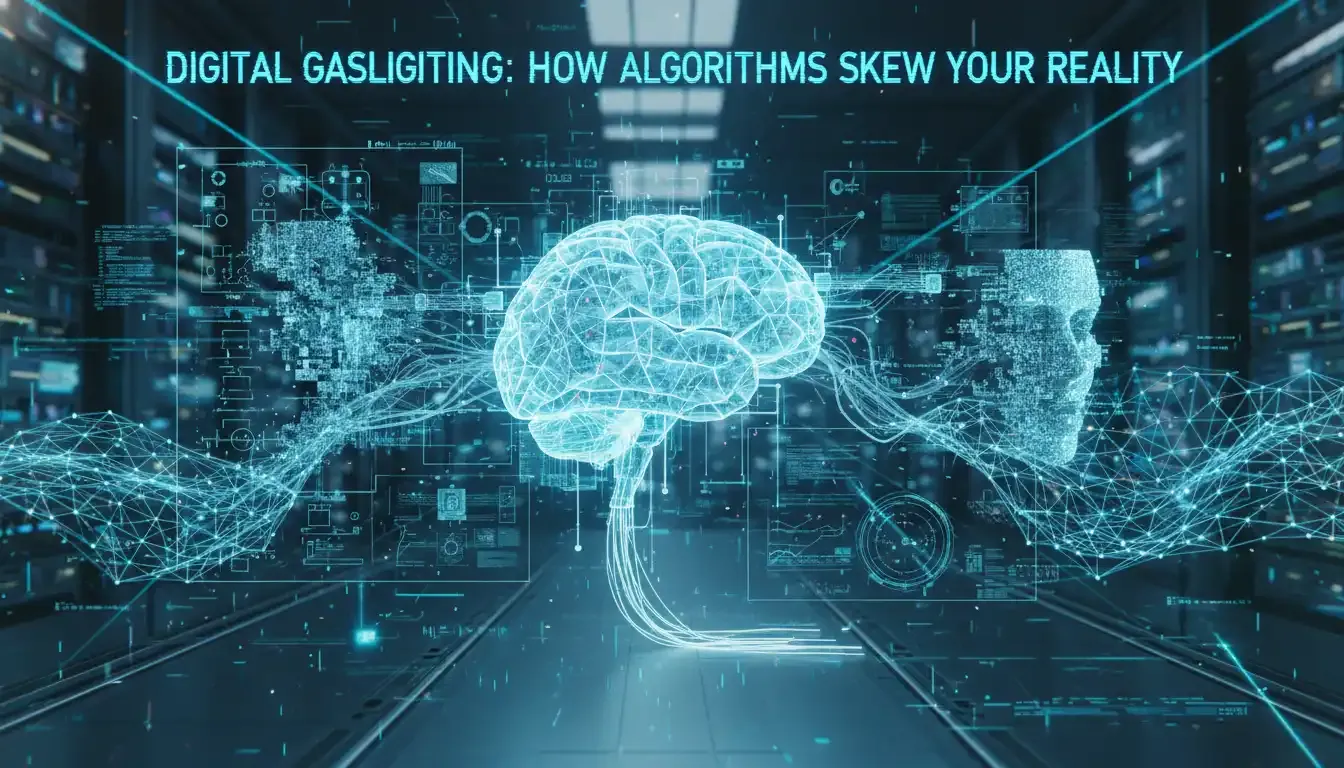
Have you ever refreshed your social media feed to show a friend an important post, only to find it completely vanished? Or perhaps you have noticed that a popular creator you follow has suddenly disappeared from your timeline, leaving you wondering if you simply imagined their past online activity. This unsettling feeling is no longer just a random computer error. It is a system-wide feature of our super-connected world. This is a subtle, widespread, and carefully designed experience that experts who study digital evidence and psychologists now call digital gaslighting. Unlike traditional gaslighting, which relies on one person manipulating another and direct emotional abuse, digital gaslighting is system-wide, automatic, and AI-driven. It happens when the hidden, changing rules that control our online platforms make us fundamentally doubt our own memories, perceptions, and understanding of what's real.
As we spend more and more of our lives navigating these AI-made digital worlds, the AI systems that sort and organize these environments hold immense, unchecked power. They decide what you see, what you miss, and how you interpret the world's news and social events around you. When these systems operate unpredictably or invisibly, they create a profound sense of mental discomfort. You are left questioning whether a post was purposely removed, if your accounts were secretly hidden from view, or if a piece of content was ever real to begin with. This detailed look explores how digital gaslighting works, how these systems are built, and how you can strengthen your defenses to protect your sense of what's real online.
The Hidden Hand of AI-Powered Content Sorting
The platforms you use daily are not fair, clear windows into the world. They are highly organized, artificially built environments. These environments are shaped by complicated designs meant to keep you online longer and boost advertising money. These systems rely heavily on group preference analysis and systems that push popular content. Group preference analysis looks at what millions of users do to guess what you will click on next. Systems that push popular content assign a value to content based on its potential to trigger immediate emotional reactions. These AI systems are constantly learning, adjusting, and changing the content you consume based on thousands of hidden bits of information.
Because these shifts happen without your clear permission, records of changes, or even your awareness, they create a highly confusing online experience. Imagine discovering a niche topic about world events and seeing your feed flooded with related, highly detailed content. You feel a sense of being well-informed. Suddenly, an AI system change happens behind the scenes. The content vanishes entirely. It is replaced by a completely different, unrelated viral trend. You might wonder if the topic was censored. You might think you lost interest. Or perhaps you believe you somehow triggered a behavioral penalty. The reality is that an AI program simply adjusted its settings. However, the psychological impact on you is one of sudden isolation and confusion. It leaves you feeling like you can't trust what you saw.
"AI systems do not explain themselves. They simply alter the landscape of our digital reality, leaving us to navigate the shifting terrain blindfolded."
The rise of the endless-scroll 'For You' page has accelerated this confusion. Unlike time-ordered feeds, which offer a predictable, linear progression of time, AI-sorted feeds are entirely detached from real-world time. You might experience the intense, dizzying feeling of endless, disjointed scrolling. You see a time-mixed-up feed where a post from three days ago sits directly beneath a breaking news update from three seconds ago. This messy setup is not a mistake. It is a deliberate design choice that cares more about getting your attention than making sense. This leaves you struggling to piece together a reliable, factual timeline.
Disappearing Content and the Digital Black Hole
One of the most upsetting ways digital gaslighting affects you is through the phenomenon of disappearing content. In the physical world, if a billboard is taken down, you usually see the physical evidence of its removal. In the digital realm, content is simply erased from the server. This creates a modern 'digital black hole.' Inconvenient facts, controversial posts, or targeted accounts are vanished without a trace. This leaves no digital trace for you to analyze.
The Reality of Secretly Hiding Your Posts
Secretly hiding your posts, often called shadowbanning, is a powerful, harmful example of this dynamic. You might continue posting, believing your voice is being broadcasted. Meanwhile, the AI system has secretly stopped others from seeing your posts. The changes you see on screen during a shadowban are hauntingly subtle. You experience the chilling reality of zero likes, zero comments, and zero shares. You might notice invisible comments. These are replies you can clearly see when logged into your own account. However, they completely disappear when viewed from a private browsing mode or a secondary device. This creates a deeply unsettling disconnect between your perception of your online presence and the actual digital truth of your isolation by the AI. You may wonder if your network is ignoring you. Or you might think your content has suddenly become irrelevant.
Silent Deletions and Removing Digital Clues
Similarly, when platforms remove content for violating unclear platform rules, they rarely provide detailed, verifiable reasons to the broader audience. A viral video documenting a critical event might disappear overnight. If you try to reference it in conversation, others might not know what you are talking about. To make matters worse, platforms routinely engage in removing digital clues. They automatically remove the hidden photo details, location, and time info from files uploaded to their servers. When content is deleted, the removed digital clues ensure that even if you managed to save a local copy, proving its original source, context, and timeline becomes a digital detective's nightmare. Without a provable online record to point to, you might begin to question your own memory. Did the video really exist? Was it as popular as you thought? This constant vanishing act forces you to rely on screenshots and external content saving tools to prove your own experiences.
Traditional vs. AI-Driven Gaslighting
To fully grasp how serious this issue is, we must differentiate between human-driven manipulation and machine-driven distortion. The following table outlines the core differences:
| Feature | Traditional Gaslighting | AI-Driven Gaslighting |
|---|---|---|
| Perpetrator | An individual (partner, boss, friend). | Hidden AI systems and platform policies. |
| Motive | Control, power, and evasion of accountability. | Maximizing your attention, advertising money, and keeping you online. |
| Method | Verbal denial, lying, shifting blame. | Secretly hiding posts, silent deletions, time-mixed-up feeds. |
| Scale | One-on-one or small group dynamics. | System-wide, affecting billions of users simultaneously. |
| Evidence | Relies on personal memory and witness accounts. | Thwarted by removing digital clues and disappearing trails. |
Unpredictable Platform Rules
Another major pillar of digital gaslighting is the unpredictable application of platform rules. Social media platforms use a combination of AI and human checkers to police billions of posts daily. This approach inevitably leads to huge differences that leave you baffled and frustrated. You might see a post containing obvious false information remain active for weeks. Meanwhile, a harmless, context-dependent joke is instantly flagged and removed by an automatic checker. This inconsistency can make you feel like the rules are arbitrary and unfair.
The Complicated Process of Appeals
When you attempt to appeal these random decisions, you are thrust into a complicated, frustrating process. The appeals processes are almost entirely handled by computers, offering no opportunity for a detailed reason or human review. You might receive a generic notification stating your content violated 'platform rules' without specifying which rule or how it was breached. This lack of a fair hearing is profoundly disempowering. It reinforces the power dynamic between the all-powerful platform and you, the helpless user. When you cannot defend yourself or even understand the charges against you, the natural psychological response is to doubt your own judgment. You might start to second-guess everything you post.
Filter Bubbles and the Chilling Effect
When rule enforcement is unpredictable, you begin to hold back what you say. You second-guess your own words, wondering if a perfectly benign statement will trigger an AI punishment. This constant state of constant alertness is exhausting. It forces you to learn to think like the unpredictable AI, twisting your own communication styles to appease an invisible judge. Furthermore, this unpredictability breeds paranoia and accelerates the formation of filter bubbles. When you feel targeted by AI punishments, you retreat into closed groups with the same beliefs. In these groups, your reality is constantly validated. These filter bubbles act as a way to cope with AI trickery. However, they ultimately break apart our common online spaces, making agreement on what's real nearly impossible. You end up in your own corner of the internet, isolated from different viewpoints.
The Role of AI-Made Fakes and Fake Content
The rapid advancement of AI that creates new things has introduced a terrifying new layer to digital gaslighting. You are no longer just dealing with disappearing content or shifting AI systems. You are now facing the spread of completely fake realities powered by special AI systems that create fakes. These special AI systems pit two AI's 'brain' systems against each other to create super-real AI-made fakes. This makes AI-made fake videos, pictures, and voices nearly impossible to tell from genuine content. When you cannot trust your own eyes and ears, the foundation of objective reality begins to crumble. It becomes incredibly difficult to know what's true.
Telltale Signs and the Excuse for Dishonesty
However, close examination reveals specific telltale signs of AI fakes that AI systems often miss. These include unnatural blinking patterns, too smooth skin that erases natural pores, and subtle sound not matching where the lip movements do not perfectly match the sounds being spoken. Despite these flaws, face-swapping tech has become so accessible that bad people can seamlessly put a famous person's face onto embarrassing videos. Even if the video is later proven false, the initial emotional impact lingers. The mere existence of fake content creates an 'excuse for dishonesty,' where bad actors can dismiss genuine, damning evidence as AI-generated. AI systems prioritize highly engaging, emotionally charged content. They frequently spread this fabricated media and present it to millions of users as undeniable fact. When you are repeatedly exposed to super-real fakes, you develop a widespread doubt. You begin to doubt authentic news, genuine photographs, and real events. This state of constant doubt is the ultimate victory of digital gaslighting. It leaves you questioning everything.
How AI Trickery Affects Your Mind
The combined impact of these digital phenomena takes a severe toll on human psychology. Human beings are naturally built to seek patterns, consistency, and truth in their environments. When your main places to connect and get news become completely untrustworthy, it triggers serious mental stress. You feel a deep unease when your online world seems to contradict your own memories.
Mental Discomfort and Anxiety
Mental discomfort occurs when your lived experience contradicts the reality presented by the screen. You know you saw a specific news article, but the search engine insists it doesn't exist. This conflict generates intense worry. You may spend hours searching for lost content, driven by a desperate need to prove your own memories are right against a machine that insists you are wrong. This constant battle can be incredibly draining.
The Erosion of Trust and Fracturing Relationships
Over time, this anxiety hardens into a deep distrust. You lose trust not only in the platforms but in government and public organizations, old-school news outlets, and even your friends. If the digital world is a distorted reflection of shifting AI systems and fake content, how can anything be trusted? This AI-driven gaslighting also bleeds into your friendships and connections. When two friends are exposed to wildly different AI-sorted realities, curated by distinct AI systems that guess what you like, their basic grasp of the world diverges. One might be convinced that a specific political movement is sweeping the nation, while the other has never seen a single post about it. When they attempt to discuss these issues, they find themselves stuck, unable to agree on basic facts. This leads to accusations of ignorance or bad faith, fracturing relationships and isolating individuals within their separate online bubbles. This makes it harder to connect and understand each other.
What You Can Do Right Now
While you cannot control the secret designs that govern our platforms, you can control how you interact with them. Protecting yourself from digital gaslighting requires an active, detective-like way to get your information and a healthy dose of digital skepticism. Here are several simple steps to help you maintain your digital sanity:
- Get news from many sources: Do not rely on a single AI-sorted feed for your news or social interaction. Actively seek out direct sources, subscribe to newsletters from individual creators, and bypass AI systems that push popular content by using time-ordered feeds whenever possible. This gives you a broader and more reliable view of information.
- Save online content: If you see a piece of content that seems important, controversial, or likely to disappear, take a screenshot or use an external content saving tool immediately. Creating your own reliable record is a powerful defense against removing digital clues and the digital black hole. It ensures you have proof of what you saw.
- Engage with intention: Be mindful of how your clicks and watch time train the AI system. Actively control what you see by unfollowing accounts that spread questionable information and engaging with reputable sources. This helps prevent being pushed into AI-created filter bubbles, where you only see one viewpoint.
- Use checking tools: As AI fake-making tech and face-swapping become more common, your gut feeling is no longer enough. Leverage specialized AI fake-spotting tools to verify the authenticity of questionable content before accepting it as fact. These tools can help you spot the subtle signs of a fake.
By taking control of your content sorting, you significantly reduce the AI system's power to dictate your reality. You become an active participant in shaping your online experience, rather than a passive recipient of whatever the algorithm decides to show you.
Frequently Asked Questions
What exactly is digital gaslighting?
Digital gaslighting is the system-wide psychological manipulation caused by hidden AI systems and unpredictable rule enforcement that makes you doubt your online reality. It involves phenomena like secretly hiding your posts, disappearing content, and the AI spreading of fake content, leaving you questioning your own memories and perceptions.
How do AI systems contribute to this phenomenon?
AI systems actively distort reality by constantly changing the content you see based on hidden popularity scores. Because these shifts happen without warning or explanation, they make your digital environment feel unstable and unpredictable, leading you to question why certain content appears or vanishes.
Can AI-made fakes be considered a form of digital gaslighting?
Yes, AI-made fakes are a primary weapon of digital gaslighting because they present fabricated events as undeniable reality. When these fake creations are amplified by AI systems, they force you to constantly question the authenticity of what you are seeing and hearing, deeply destabilizing your sense of truth.
How can I tell if I am being secretly hidden from view (shadowbanned)?
You can identify a shadowban by looking for zero likes, zero comments, zero shares, and invisible comments that disappear when viewed from a private browsing mode. While platforms rarely admit to doing it, a sudden, inexplicable drop in reach where your posts no longer appear in hashtag searches is the clearest sign.
Reclaiming the Truth in an AI-Made World
Digital gaslighting is a complex, widespread danger that will only grow more challenging as AI and AI content sorting become more sophisticated. The feelings of doubt, confusion, and isolation you experience online are not in your head. They are the direct result of platforms prioritizing your attention over transparency. To navigate this shifting landscape, you must equip yourself with the right knowledge and the right tools. You cannot allow AI systems and fake content to dictate your understanding of reality. You must actively seek out the truth and protect your online spaces from manipulation.
At Truth Lenses, we are dedicated to helping you anchor your digital reality. Our advanced AI fake-spotting tools empower you to verify the authenticity of the content you consume. Whether you are analyzing a suspicious photograph with our picture checking tool or verifying a questionable clip through our video checking tool, we provide the clear evidence you need. Learn more about our mission on our Blog or discover How It Works to start protecting what's real online today.