Why Your Brain Falls for Fakes: The Hidden Science of Mental Shortcuts
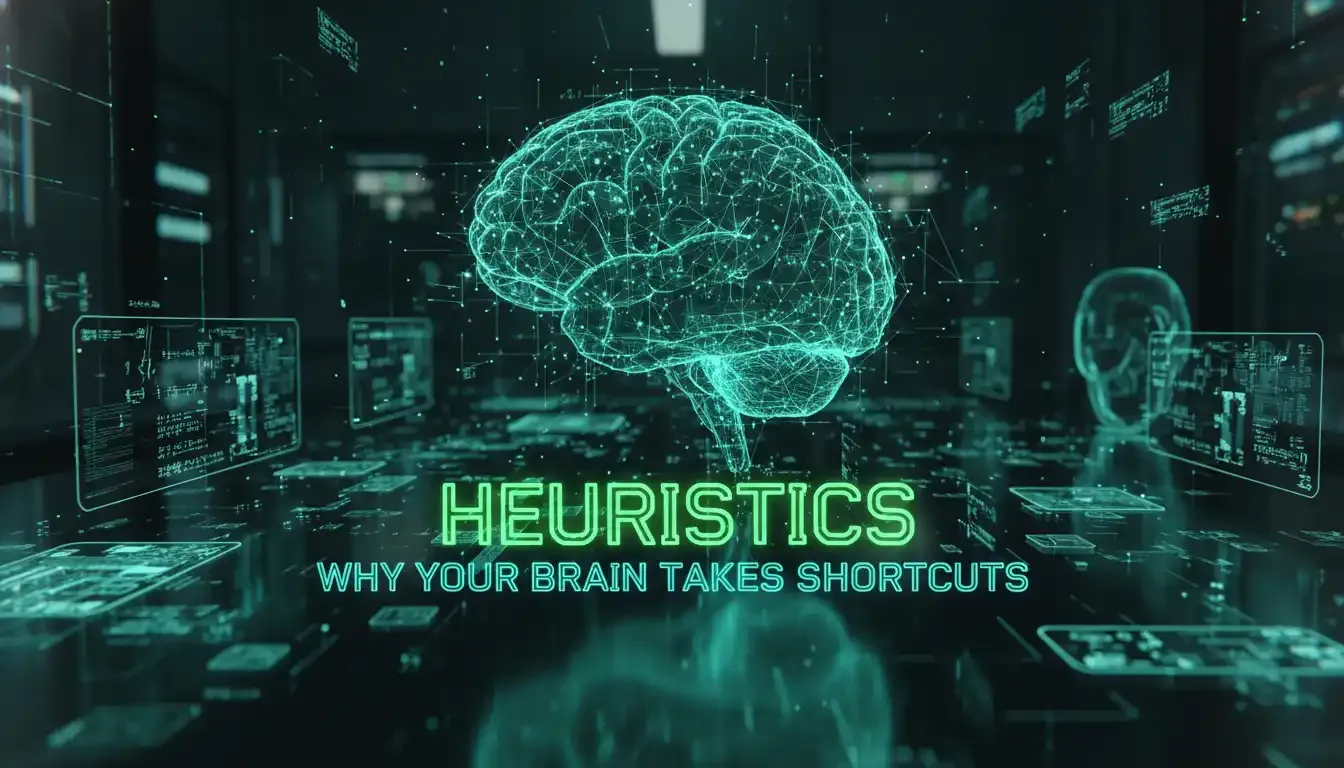
Let's talk about how your brain works. It's important to understand a basic truth about how we think. Your brain isn't really built to find the absolute truth. Instead, it's designed to help you survive and make quick decisions. Imagine our ancestors on the ancient plains, the Pleistocene savannah. They needed to react instantly to a rustle in the grass, deciding if it was a harmless breeze or a dangerous predator. There was no time for deep thought. This is why your brain uses mental shortcuts, also known as heuristics. These are quick 'rules of thumb' that let you make fast choices without thinking through every single detail.
These mental shortcuts were incredibly useful for staying alive back then. However, in today's digital world, these very shortcuts have become big weaknesses. They make you vulnerable to advanced AI-made fakes, like those created by powerful AI systems that generate fakes (often called Generative Adversarial Networks, or GANs). These fakes are designed to trick your brain's natural tendencies.
How Your Brain Makes Decisions: Two Ways of Thinking
If you want to understand why we can be so easily fooled by AI-made fakes, you need to look at how your brain is built to think. Researchers Daniel Kahneman and Amos Tversky showed that human thinking happens in two main ways. Think of them as two different 'systems' in your brain.
System 1 is your brain's automatic pilot. It's incredibly fast, works on instinct, and is often driven by emotions. It takes almost no conscious effort from you. This is where your mental shortcuts live. For example, when you see a video and instantly 'feel' that the person speaking is a famous politician, that's System 1 working. It quickly recognizes patterns and uses immediate visual clues to make a snap judgment. It helps you make quick decisions, like slamming on the brakes when a car suddenly stops in front of you. This system is always on, constantly scanning your environment and making assumptions based on past experiences. It’s efficient, but not always accurate, especially when faced with something truly new or deceptive.
System 2, on the other hand, is your brain's careful detective. It's much slower and uses a lot more energy. This system is in charge of complex math problems, figuring things out logically, and the careful checking you need to spot a clever AI-made fake video or image. But here's the catch: your brain is a bit lazy when it comes to energy. It prefers to use System 1 whenever it can, just to save mental fuel. This preference for 'easy thinking' is the main reason why false information and AI-generated content can so easily sneak into what you believe. It's a fundamental design flaw in our brains when confronted with sophisticated digital trickery.
How Bad Actors Use Your Mental Shortcuts Against You
At Truth Lenses, we've looked closely at how your brain works. We've found three main mental shortcuts that dishonest people use to get around your natural skepticism. They want you to believe their fakes without thinking twice.
1. The 'Looks Real, Must Be Real' Shortcut (Representativeness Heuristic)
This mental shortcut makes you judge something based on how well it fits what you already expect. Think of it this way: if a video looks exactly like a real news report, your brain quickly decides it is a real news report. It might have a scrolling text banner, a familiar news anchor, and professional lighting. Your brain labels it 'trustworthy news' even before you fully listen to what's being said. You're not even processing the actual words. This quick categorization saves your brain effort, but it leaves you open to deception.
People who create AI-made fakes use this to their advantage. They use AI systems that generate fakes (Generative Adversarial Networks, or GANs) to make their creations look incredibly realistic. These AI systems learn from countless hours of real videos and images. They become so good that the fake output perfectly matches how you expect a real person to look and sound. This includes tiny facial movements and the rhythm of their voice. Once this 'looks real' shortcut is satisfied, your slower, analytical System 2 often doesn't even kick in to check for problems. It simply accepts the fake as real, because it fits your mental picture of reality.
2. The 'Heard It Before, So It's True' Shortcut (Availability Heuristic)
This mental shortcut makes you believe something is important or true if you can easily remember it. The more you hear something, the more real it feels. In today's online world, this is often manipulated by groups using 'coordinated fake behavior.' This means they use networks of automated accounts, called botnets, to flood social media with a specific story or idea that's often supported by AI-made fakes.
Imagine seeing the same fake video or claim pop up again and again across different social media sites. Because you encounter it so often, that information becomes very 'available' in your memory. Your brain mistakenly thinks that if something is easy to recall, it must be true. From our perspective, this is like 'mentally flooding' you. It's designed to overwhelm your ability to carefully check if something is real. This constant repetition makes the fake feel familiar and therefore, more credible, even if you haven't actually verified it.
3. The 'First Impression Sticks' Bias (Anchoring Effect)
This is a mental bias where the very first piece of information you come across, called the 'anchor,' strongly influences all your later judgments. Let's say an AI-made fake video is the first thing you see about a breaking news story. That video then becomes your 'anchor.' It sets your initial understanding of the event. Your brain latches onto this first piece of information, making it difficult to shift your perspective later.
Even if solid evidence later shows that the video was completely fake, that first emotional and mental impact often remains. It's much harder for your mind to 'un-see' a fake once you've believed it. It's like trying to erase a strong first impression. This is why getting accurate information first is so crucial. The initial 'anchor' can subtly, or even overtly, bias all subsequent information you receive, making you less likely to accept corrections.
The 'Truth Gap': Where Your Biology Can't Keep Up with AI
Our ancestors lived in a world where seeing truly was believing. If you saw a dangerous animal, it was really there. Your survival depended on trusting your eyes. There was no need for humans to develop a way to defend against a super-realistic fake image of a predator. This history has left us with a 'Truth Gap.' This is a space where your natural senses simply can't spot the subtle clues left by modern AI-made fakes.
For instance, your eyes usually can't spot flickering or unnatural movement (what experts call Temporal Inconsistency) in a fast-moving video. You won't notice the tiny, pixel-level jitters that happen when an AI model struggles to keep every frame perfectly consistent. Likewise, you can't instantly look for hidden digital noise (Frequency Domain Analysis) to find the specific patterns that show an image was created by an AI system that generates fakes. These are microscopic details that our biological vision system isn't equipped to process in real-time, making us inherently vulnerable to sophisticated digital manipulation.
How Technology Helps: The Truth Lenses Approach
At Truth Lenses, we step in to close this 'Truth Gap.' We use a digital 'System 2' that works tirelessly, without ever taking shortcuts. Our tools use several smart techniques to spot what your human brain simply can't. We act as your tireless digital detective, scrutinizing every pixel and sound wave for inconsistencies.
- Checking for a Real Heartbeat in Faces (Photoplethysmography or PPG Analysis): Real human skin subtly changes color with each heartbeat as blood moves through tiny vessels. You can't see this with your naked eye. But our computer programs can spot these rhythmic pulses. Most AI-made fake videos don't have this real biological sign, or the 'pulse' isn't consistent across the person's face. It's a dead giveaway that the person isn't real, or their face has been digitally altered. This subtle biological rhythm is incredibly difficult for AI to perfectly replicate.
- Checking Eye Reflections (Specular Highlight Verification): We look closely at the tiny reflections in a person's eyes. In a real setting, the light source should be the same in both eyes and match the lighting in the background. AI often struggles to create these tiny reflections perfectly and accurately. In a real image, these reflections offer crucial clues about the environment and the subject's position, which AI frequently gets wrong, even in seemingly perfect fakes.
- Camera Sensor Fingerprint (PRNU, or Photo-Response Non-Uniformity): Think of it like this: every physical camera has a unique 'fingerprint' because of microscopic differences in its sensor. Images created by AI don't have this consistent camera fingerprint. This allows us to identify them as creations that didn't come from a real camera. It's like finding a unique signature on a piece of art, but for digital images, allowing us to distinguish between genuine captures and AI fabrications.
- Smart AI Detectors (Convolutional Neural Networks or CNNs): We train special deep learning AI models to recognize the unique 'fingerprints' left by different AI systems. For example, they can tell the difference between fakes made by Midjourney and those made by DALL-E 3, because each leaves distinct digital clues. These advanced detectors are constantly learning and evolving, much like the AI models that create the fakes, ensuring we stay one step ahead in the fight against deception.
What You Can Do Right Now: Your Personal Checklist
While technology is your strongest defense, you can also adopt a 'truth-seeking mindset' when you look at digital content. Use this simple checklist to activate your slower, analytical System 2 thinking:
- Check the Digital ID Stamp (Source Provenance): Can you trace the video or image back to its original, trusted source? Look for digital ID stamps or other clues to see where it really came from. Think of it like checking the chain of ownership for a valuable item. If you can't find a clear origin, be skeptical.
- Look for Biological Clues: Pay attention to details like hair and ears. Does the hair blend naturally into the background? Or do you see a strange 'blur' or 'halo' around the edges, suggesting it might have been cut and pasted? Also, watch for unnatural skin tones, textures, or even strange blinking patterns in videos. Any slight imperfection can be a clue.
- Check the Lighting: Does the light on the person's face match the shadows and lighting in the background? AI often struggles to create realistic lighting that makes sense for the whole scene. Look for inconsistencies, like a person lit from the front while the background shows light from the side.
- Watch for Unnatural Movements (Video Only): If it's a video, slow it down to half speed. Watch the eyes and mouth very carefully. Do the teeth look like they're merging into one solid white block? Do the eyes blink at the same time and in a natural way? Look for any jerky movements or parts that just don't look right. Even subtle distortions can reveal a fake.
- Listen Carefully: If there's audio, does the voice sound natural and match the person's mouth movements? AI-generated voices can sometimes have an unnatural cadence or lack emotional depth. Any mismatch between what you see and what you hear is a red flag.
The Future: Your Mind as a Target
We are now in a time of 'mind hacking.' The goal isn't just to break into computer systems anymore. Instead, it's to directly target your human mind. By understanding your mental shortcuts, dishonest people can create content that perfectly slots into how your brain naturally works. This is why the work of Truth Lenses is so vital. We aren't just finding fakes. We are protecting your ability to trust what you see and hear. We are defending the very integrity of human perception.
As AI gets even smarter, that slightly creepy feeling you get from things that look almost human, but not quite (what's known as the Uncanny Valley), is fading away. Soon, the visual evidence from AI-made fakes will be so flawless that your mental shortcuts will always default to 'True.' In this new world, the only way to truly hold onto reality is by using precise, data-driven technology to find the truth. Your human senses alone will no longer be enough.
Conclusion: Making Your Mind Stronger Against Fakes
Your mental shortcuts are a permanent part of being human. You can't just 'update' your brain's software to stop using them. But you can make yourself stronger by knowing where your weaknesses lie. When you understand that your brain naturally wants to take the easiest path, you can consciously decide to slow down. You can choose to use your analytical thinking. And you can use powerful tools like Truth Lenses to check what's real in the digital world.
In this ongoing fight between your brain's quick shortcuts and clever AI-made fakes, hard data is the only truly unbiased judge of truth. Don't always trust your first feeling. Instead, trust the solid evidence that technology can uncover. In the age of AI-made fake videos and images, taking a mental shortcut could mean losing our shared understanding of what's real. So, stay alert, keep questioning, and always double-check.