Why AI Makes Things Up: Your Guide to Spotting Fake AI Content
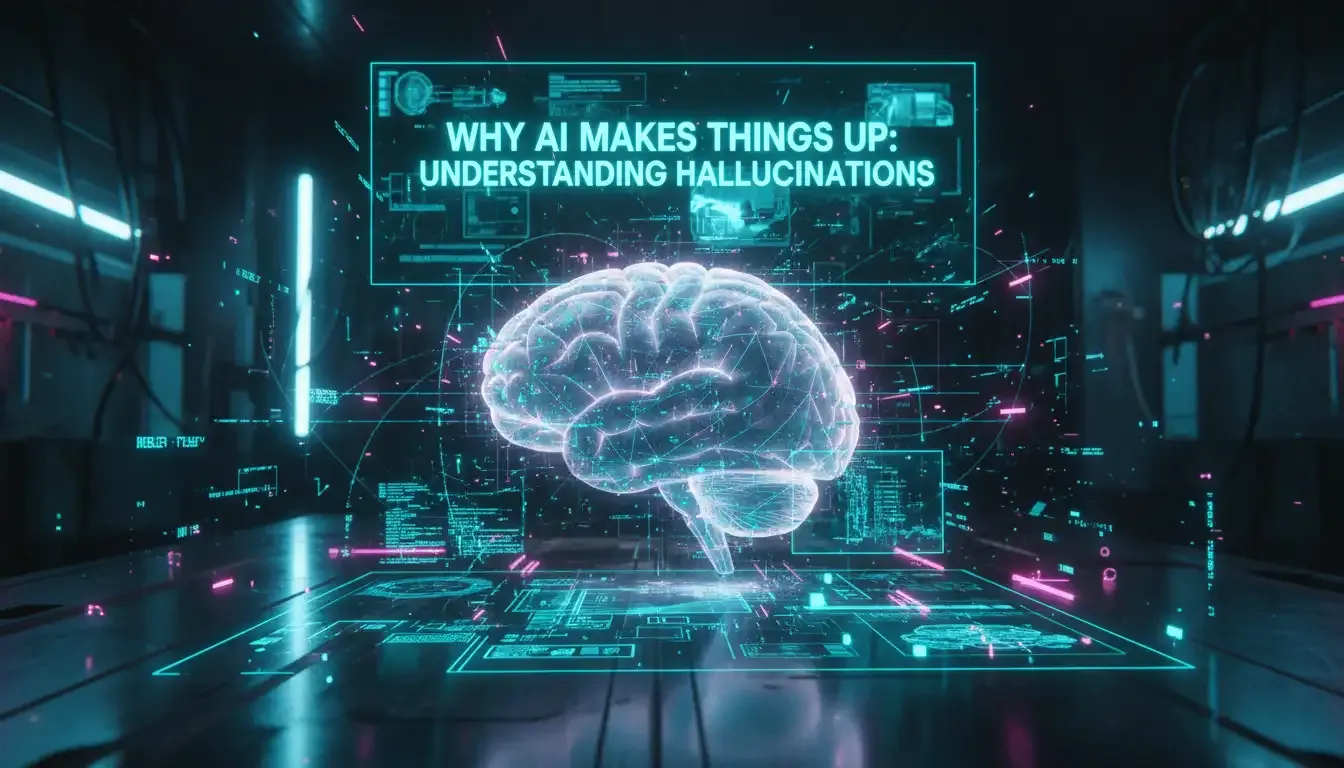
Today, we see more and more AI-made fake content. People often say AI is 'hallucinating' when it creates information that isn't true or doesn't make sense. But from a closer look, that word isn't quite right. AI doesn't have a mind to 'hallucinate' like a person does. Instead, it's more like AI making things up. It fills in gaps by guessing what sounds most likely, based on patterns it learned.
Here at Truth Lenses, we see these mistakes not as simple errors, but as a basic part of how these powerful AI systems, called Large Language Models or LLMs, are built. Think of them as an AI that just repeats patterns. We're using these AI systems in really important areas, like essential services, legal work, and news reporting. So, it's super important for you to be able to break down and spot when AI is inventing facts.
This guide will give you a complete look at why AI invents facts. We'll show you how it tries to trick you and how you, even if you're not a tech expert, can protect the truth in a world full of believable AI-made fake stories.
1. The Guessing Machine: Probability Over Truth
To understand why AI makes things up, you first need to stop thinking of it as truly 'intelligent' like a human. Today's big AI systems, or LLMs, are built using a basic design called the Transformer Architecture. This design uses something called an Attention Mechanism to figure out which parts of the information you give it are most important. When you ask an AI a question, it's not looking up facts in a giant database. Instead, it's sifting through a complex mathematical map. It's trying to guess the next most likely small piece of a word.
The AI That Just Repeats Patterns
Experts often call these AI systems 'AI that just repeats patterns'. This name means the AI is just repeating patterns it learned from its training data. It doesn't truly understand the real world or what's logically true. For example, if you type 'The capital of France is,' the AI figures out that the most likely next small piece of a word is 'Paris'. But if your question is really vague or complicated, the AI's internal map of what's likely might lead it to say something with great confidence. This confident answer could be completely made up. This is the main problem with the trap of sounding believable. The AI is designed to sound smooth and coherent, not to be factually correct.
2. Navigating the AI's Internal Map of Knowledge: Where AI Makes Things Up
When an AI is learning, it squeezes huge amounts of human knowledge into what we call its internal map of knowledge. Think of this as a complex mental map where all related ideas are grouped close together. When the AI creates an answer for you, it's basically drawing a path through this internal map. AI making things up happens when this path goes into 'empty' or 'confused' areas of its internal map of knowledge.
Let's say you ask an AI about a legal case that doesn't actually exist. The AI will look at the groups of information it has for 'legal words,' 'court cases,' and 'how to format citations'. Then, it puts together a new 'fact' that seems to fit where these different groups of information overlap mathematically. The result is a legal citation that looks perfectly real. It will have volume numbers and judge names. But it won't exist anywhere in the real world. This isn't a 'lie' like a human would tell. It's more like the AI guessing to fill in gaps where it doesn't have much real information.
3. How AI Breaks Down Words and Its Short-Term Memory
When we look closely at AI's mistakes, we often find that how AI breaks down words is a big reason why things go wrong. AI doesn't actually 'read' words like you do. It reads numbers that represent parts of words or characters. This is why these AI systems often have trouble with simple math, spelling, or logic puzzles. For example, asking 'How many 'r's are in Strawberry?' can confuse them. If the way the AI breaks down words hides the real meaning or structure of the information, then its guesses will be completely wrong.
Also, every AI system has a limited short-term memory. This is the amount of text it can 'remember' during one conversation with you. As your conversation with the AI continues, it has to get rid of older information. This makes space for new small pieces of words. When its short-term memory is full, the AI loses its connection to the facts you've already discussed. This can lead to it contradicting itself or its logic going off track. If you're trying to figure out why an AI suddenly started making things up, finding the point where its short-term memory got too full is often the answer. It can explain a quick switch from facts to fiction.
4. AI Learning from Human Ratings: The Drive to Sound Confident
One of the trickiest reasons AI makes things up is something called AI learning from human ratings. During a special training stage, human testers rate the AI's answers. It turns out that humans usually prefer answers that sound confident, polite, and complete. If an AI says, 'I don't know,' people often give it a lower rating. They tend to prefer an AI that gives a detailed explanation, even if it's a little wrong. So, these AI systems are basically trained to be 'Yes-Men.' They learn to always give an answer, even if they have to invent it.
They learn that sounding confident gets them better ratings than admitting they don't know something. This creates a built-in bias. The AI will put looking helpful ahead of being strictly truthful. This often leads to it creating misinformation that sounds very believable.
5. Fake Images and Sounds: Beyond Text
Here at Truth Lenses, we don't just look at text. We also focus on fake images and sounds. The same ideas about AI making things up also apply to AI systems that create images and another type of AI that creates images. When an AI creates an image, it's guessing what each tiny dot, or pixel, should look like. It bases these guesses on patterns it has learned.
Visual Clues and Warning Signs
Fake images often show things that are impossible for bodies or objects in the real world. This is because the AI doesn't truly understand how bodies work or the laws of physics. So, it might create:
- Body Mistakes: You might see extra fingers, arms blending into the background, or teeth that look like a solid block instead of individual teeth. For example, a person in an AI-generated image might have six fingers on one hand, or their arm might just melt into the wall behind them.
- Wrong Lighting and Shadows: Look for shadows that don't match where the main light source is coming from. Or you might see reflections that don't make sense for the object being reflected. For instance, a person's shadow might point left, but the sun is clearly shining from the right.
- Hidden Digital Details: Many AI-made images have missing or strange hidden digital details. These details, often called EXIF data, can show signs of being fake. You might see 'Software: Midjourney' listed, or the image might have unusual size patterns that don't match any real camera.
6. Real-World Risks: A Legal Example
The dangers of AI making things up are not just theories anymore. They are happening in real life. In 2023, there was a big legal case where a lawyer submitted court papers that included six completely fake court decisions. An AI, ChatGPT, had created all of them. The AI didn't just invent the names of these cases. It also wrote detailed, convincing-sounding legal opinions for each one. They looked like real court documents, complete with official-sounding names and dates.
From a close-up look, this was a classic example of the AI losing its grip on reality. The AI was asked to do something, legal research, but it didn't have access to a verified database of real legal cases. It had no reliable source of truth. So, it relied only on its internal map of what legal language should sound like. It guessed what was most probable. This case shows why it's so important to have a human checking the AI's work. It also proves you need special tools to compare what the AI says against original, trusted sources.
7. How to Spot When AI Makes Things Up: Your Everyday Checklist
To lower the risks of misinformation created by AI, Truth Lenses suggests you take a careful, investigative approach every time you interact with AI. Use this checklist to make sure the digital content you see is real and trustworthy:
- Check the Sources: Never just click a link or trust a quote an AI gives you. Always check it against an original, non-AI source. AI often invents website addresses that look real but lead nowhere.
- Look for Contradictions: Does the AI say one thing and then something different in the same answer? Does it change its mind about a date or a name partway through the text?
- Ask Tricky Questions: Try asking the AI about something that never happened, as if it were real. For example, 'Tell me about the 1994 Martian landing.' If the AI agrees and gives you details, it means it's not well-connected to reality. You should then be very suspicious of anything else it told you.
- Examine Images Closely: If you're looking at an image, zoom in on tricky parts like hands, eyes, and background details. Look for blurry areas or strange distortions. These often show that the AI didn't truly understand how to build the image correctly.
- Use AI with Trusted Sources: If you use AI for important work, try to use systems that include AI using a specific, trusted source. This makes the AI get its information from a known, verified set of data. It won't just rely on its own internal map of knowledge.
8. The Truth Lenses Mission: Restoring Digital Trust
As AI systems get smarter, the difference between what's real and what the AI has made up will get harder to tell. At Truth Lenses, our goal is to give you the investigative tools you need to find your way through this new digital world. Our platform uses smart computer programs to spot the tiny clues that show text, images, and videos were created by AI. We believe the answer to AI misinformation isn't less technology. It's about having better ways to check facts. When you understand how these AI systems are made, and why they tend to invent facts, you can use their power wisely. You can stay connected to the truth. Check out our how-it-works section to see how we're building the future of digital investigations.
What You Can Do Right Now
Here are some simple steps you can take today to protect yourself from AI-made fake content:
- Always Double-Check: If an AI gives you facts, dates, or names, always look them up somewhere else you trust, like a reputable news site or an official government website.
- Watch for Weird Details in Images: Zoom in on AI-made pictures. Look closely at hands, eyes, or backgrounds for anything blurry, distorted, or just plain strange, like extra fingers or shadows that don't make sense.
- Ask "What If?" Questions: Test the AI by asking about made-up events. If it confidently gives you details about something fake, be extra careful about everything else it tells you.
- Know AI's Memory Limits: Remember that AI can forget earlier parts of your conversation. If an AI starts contradicting itself, its short-term memory might be full, and it could be inventing facts.
- Be Skeptical of "Too Perfect" Answers: AI is trained to sound confident and helpful. If an answer seems too good, too detailed, or too smooth, it might be hiding made-up information. Always question what you read or see.
Frequently Asked Questions
What's the difference between AI making things up and a human lying?
A lie needs someone to intend to deceive and know the truth. An AI has neither of these. When an AI makes things up, it's a statistical error. The AI predicts a sequence of words that sounds believable but is actually wrong, based on its training data.
Can we stop AI from making things up by giving it more data?
Not completely. While more data can make the AI more accurate, the basic way these AI systems are built means they always work on probabilities. There will always be a small chance that the 'most likely' next word or phrase is actually incorrect.
How does Truth Lenses detect AI-generated content?
We use a mix of methods. We look for repetitive patterns often found in AI-generated text. We also use pixel-level investigations to find the mathematical clues left behind by AI systems that create images.
Is using AI with trusted sources the complete fix for AI errors?
AI using a specific, trusted source (RAG) greatly reduces how often AI makes things up. It gives the AI a 'source of truth' to check against. However, the AI can still misunderstand or misrepresent the information it gets. So, a human still needs to oversee its work.
Conclusion: The Price of Sounding Believable
AI reflects human language, but it's not a storage place for human truth. Its ability to sound authoritative comes from its training, not from actual understanding or knowledge. As we move into a digital world where truth can be hard to find, it's up to us to verify information. You should treat what AI tells you as a starting point for your own investigation, not as the final answer. By using investigative tools like those at Truth Lenses, we can make sure the AI age is about progress, not about trickery.