The Crisis of AI-Made Law: Spotting AI Ghostwriting in Your Legal Contracts
The digital world often talks about fake pictures and cloned voices. We hear a lot about visual tricks. But a more sneaky danger is quietly slipping into the core of how businesses operate. This danger is the AI-made fake text.
In the intense world of corporate legal teams, there's huge pressure to get things done faster. This has led many to quietly start using AI writing tools, also known as Large Language Models (LLMs), to draft complicated contracts. These tools offer amazing speed. However, they also bring a huge problem: AI-made clauses that look, sound, and feel like real law, but are entirely made up by a computer. This is the time of AI ghostwriting. The real danger isn't a fake image. It's a false sentence hidden in a 100-page important business contract (MSA) that could cost a company millions of dollars. The trustworthiness of our legal system is at risk because of how efficient these "Stochastic Parrots" are.
The Rise of AI-Made Fake Text
When you think of fake content, you probably imagine fake pictures or fake videos that twist what's real. However, AI-made fake text is arguably even more dangerous. It's often harder to spot. Plus, it carries immediate legal weight, meaning it can cause instant legal problems for you or your business.
An AI-made clause in a legal contract is a piece of text created by an AI. It might seem legally correct. Yet, it could contain laws that don't exist, terms that contradict each other, or made-up duties. AI writing tools are built to sound convincing, not necessarily to be factual. This means they can weave these errors into a document with such a confident writing style that even experienced lawyers might miss them during a quick review. This isn't a mistake in the AI system. It's a core feature of how the AI's brain, called the Transformer architecture, works. This is the same design that powers models like GPT-4o and Claude 3.5 Sonnet.
In big business contracts, these made-up facts often appear in the most complex parts. These include sections about who is responsible for what, how much money someone can be sued for, and rules about protecting private information. For example, an AI might create a clause that refers to a non-existent "Data Protection Law of 2025." It might also mention a specific legal case that was never decided. These aren't just typos. They are serious problems that break the trustworthiness of the document. As businesses move towards automated drafting, carefully checking documents becomes super important. You need to make sure the "ghostwriter" hasn't put a hidden trap into your agreement. The risk isn't just a simple error. It's a widespread breakdown of what's true within legal papers.
The AI's Brain: Why AI Makes Things Up
To understand why AI writing tools produce these dangerous made-up facts, you need to grasp the basic design of how these AI brains are built. AI writing tools don't "know" the law. Instead, they predict the next word in a sentence based on huge amounts of information they've learned. This process uses a special part of the AI, called a Softmax layer. This layer assigns probabilities, or likelihoods, to potential next words.
When an AI drafts a contract, it's essentially making choices based on many, many possibilities for what word comes next. If the AI encounters a request that needs very specific, niche legal knowledge, and that knowledge wasn't strongly emphasized when the AI learned, it doesn't stop. Instead, it selects the most statistically likely next word that sounds like legal writing. This is called the "Stochastic Parrot" effect. It means the AI mimics the form of legal reasoning. However, it does so without any real understanding of the actual meaning or substance.
Also, a special setting of the AI, called the "temperature" setting, plays a critical role. This is like a control knob that determines how random or creative the AI's predictions are. At low temperatures, the AI is careful and tends to repeat itself. At higher temperatures, it becomes "creative." In a legal context, "creative" is really a polite way of saying "making things up." Our careful checks show that many business-grade AI writing tools are set to balance sounding smooth and being accurate. But even a tiny 1% difference in how likely a word is can result in a clause that changes a responsibility limit from $1 million to $1 billion. The mathematical way these AI models are built means they cannot check their own answers against the real world. They need another system to help them verify the information.
How We Spot AI Fakes: Predictability in Writing
To find AI ghostwriting, experts who study language to solve problems, and tools like Truth Lenses, use a measurement called perplexity. In simple terms, perplexity measures how "surprised" an AI writing tool is by a piece of text. Think of it as how predictable the writing is to an AI. It comes from a math calculation called cross-entropy, which measures how unpredictable text is. AI writing tools are built on probability. They prefer the most likely path. Because of this, AI-generated text tends to have very low perplexity. It is, in a sense, too easy to guess.
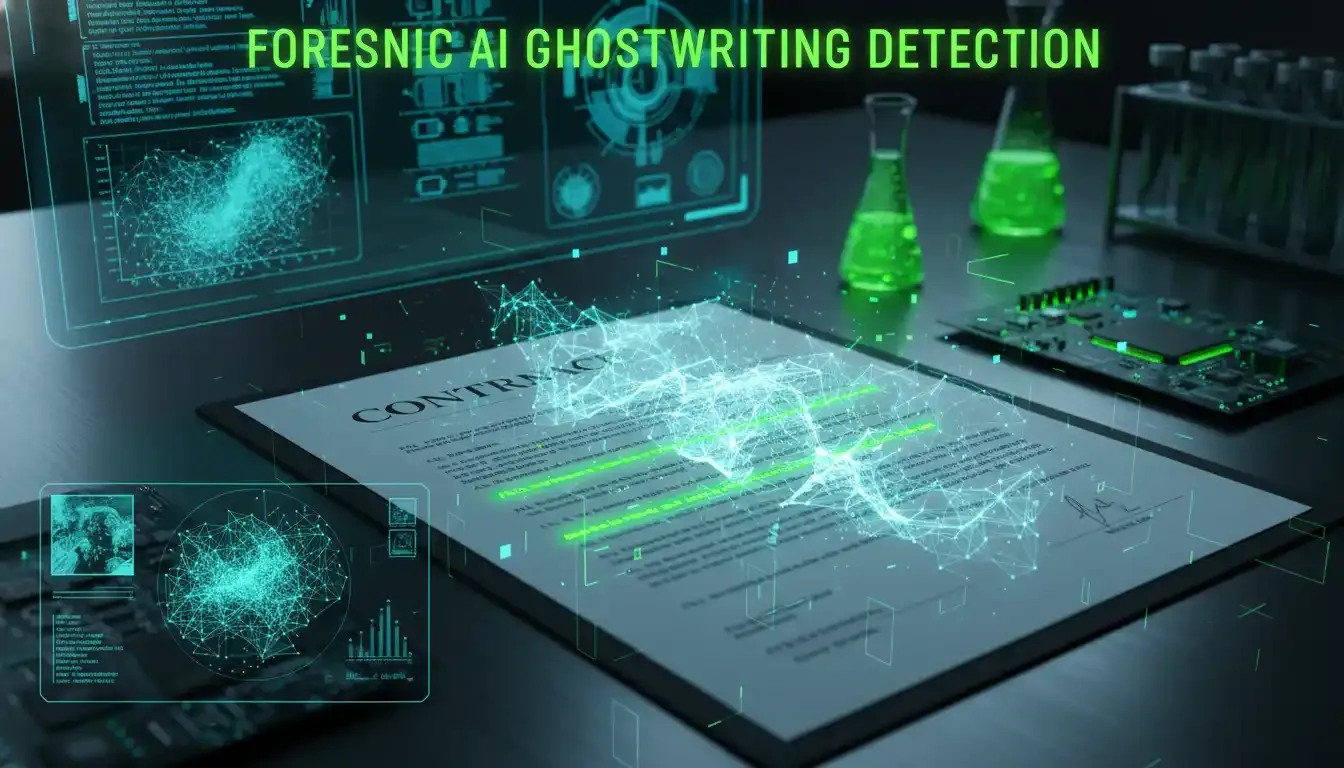
When we run a contract through our special software, we are essentially asking: "How likely is it that a machine would have predicted this exact sequence of words?" Human writing, on the other hand, is messy. Even the most formal legal writing contains "linguistic pivots." These are unexpected word choices or changes in how sentences are phrased. An AI wouldn't necessarily predict these as the most likely next step. When we analyze a 100-page contract, we look for "valleys" of low perplexity. If a specific section on intellectual property rights shows a statistical predictability that is significantly higher than the surrounding text, it's a strong sign that an AI writing tool created that section. This "statistical fingerprinting" allows us to map exactly where the human author stopped and the AI ghostwriter took over. On our special dashboard, these areas are highlighted in bright green. This signifies a "low-surprise" zone for the machine, meaning it was very predictable. These zones require a human expert to check them carefully.
How We Spot AI Fakes: The Flow and Variety of Sentences
While perplexity measures how predictable the text is at the word or phrase level, burstiness measures how much the sentence structure and length change throughout a document. Human writers naturally show lots of variety in their writing. We might write a long, complex sentence. Then we follow it with a short, punchy one. We change how we put our sentences together based on the point we are trying to make. Even in the strict world of legal drafting, a human lawyer’s unique "voice" will show through these structural variations. This is a reflection of how human brains think. We pause, we emphasize, and we change direction.
AI writing tools, however, tend to produce text with low burstiness. Their sentences often have a similar length. They also have a repetitive rhythm. They aim for an "average" style that lacks the natural ebb and flow of human thought. This is a direct result of a limitation in the AI's word-picking process. The AI is designed to create the most "average" high-quality text it can. In our checking process, we plot the sentence length and how complex a contract's structure is on a timeline. A human-written contract will look like a bumpy mountain range. An AI-generated contract often looks like a flat field or a row of identical small hills. By finding these sections of low burstiness, we can mark specific parts for a human expert to check carefully. This is important even if the legal language itself seems believable.
The Truth Lenses Checking Process: A Deep Dive
Checking a massive business contract needs more than just a quick scan. It requires a detailed, step-by-step process. At Truth Lenses, we have developed a set of steps designed to peel back the AI's fancy writing style. This process exposes its underlying computer-made structure. This workflow is essential for any legal department that has started using AI by giving it no examples or only a few examples to learn from when drafting documents.
Step 1: Breaking Down the Document
The document is first broken into meaningful pieces. These are individual clauses, sections, and exhibits. Then we turn these pieces into "tokens." Tokens are the basic units of language that AI models understand. This allows us to analyze the document at the same level of detail as the machine that may have created it.
Step 2: Analyzing Writing Style
Every law firm and corporate legal department has a "house style." This is their usual way of writing. We establish a baseline for this typical drafting style using past documents. Any big differences from this normal style are the first warning signs of AI ghostwriting. These differences could be changes in how many different words are used or how often certain word groups appear.
Step 3: Mapping Word Likelihood
We calculate how likely each word in the document was to appear. By mapping these probabilities, we can see how "certain" the AI was when it generated the text. AI text often maintains a consistently high, flat line of probability. Human text, however, shows frequent "dips" where the word choices were less predictable, showing more human creativity.
Step 4: Checking Word Patterns and AI Settings
We analyze how often certain groups of words (N-grams) appear together. AI tends to use certain common word groups too much because they were frequent in its training data. By analyzing how much these patterns change, we can even guess the "temperature" setting. This is a control knob that determines how creative or random the AI was when it wrote the text. This gives us a detailed report, like a ballistics report for a bullet, but for the digital document.
Step 5: Checking Legal Facts
Any specific legal citations, laws, or case names are checked automatically against huge global legal databases. These include services like Westlaw or LexisNexis. If the AI "invented" a legal case to support a clause, this step catches it instantly. This is our main defense against "made-up legal cases."
Step 6: Creating the Forensic Heatmap
The final output is a special color-coded map of the document. Areas that are very likely AI-generated are shown in red and bright green. Sections confirmed as human-written stay a neutral color. This allows your legal team to ignore the 80% of the document that is safe. They can then focus their costly time on the 20% that is statistically questionable. This means you can apply your expertise where it's most needed.
Seeing the Deception: The Truth Lenses Dashboard
The Truth Lenses special dashboard is designed to turn complicated numbers into clear, useful information. When you upload a 100-page important business contract, the platform creates a "Burstiness Graph." Imagine a jagged line chart that shows how much the rhythm and length of sentences change. A truly human document will show a wild, up-and-down pattern, like a heart monitor for writing. But if this line suddenly flattens out, staying almost perfectly straight, that's your visual cue. It tells you the document has transitioned from human drafting to AI generation.
Next to this graph, you'll see a "Perplexity Heatmap." Think of it like a weather map for your document. Each paragraph is shaded based on how predictable it is to an AI. Bright, intense colors, like a deep red or a glowing green, highlight sections where the AI found the text extremely predictable, almost too perfect. Cooler, neutral colors indicate areas that show the natural unpredictability of human writing. This easy-to-understand display allows legal professionals to "see" the ghost in the machine. The feeling of scrolling through a digital document and seeing the smooth, uniform feel of AI text compared to the rich, varied texture of human writing is a powerful tool in your checking toolkit.
Case Study: The $50 Million Made-Up Fact
In a recent study, we analyzed a 120-page important business contract. This contract had been drafted using a well-known AI writing tool for a huge business deal for a major company. Just by looking at it, the document seemed flawless. However, our careful checks flagged a specific clause in the "Indemnification" section. This is the part about who is responsible for damages. The clause referenced a "Standard Liability Protocol 402-B" as the governing framework for data breaches.
Our check of how likely each word was to appear showed that this specific phrase had a very, very high score for predictability. Yet, our check against real legal databases found nothing like it. Upon investigation, it was discovered that "Standard Liability Protocol 402-B" did not exist. The AI had made up this term because it sounded like a believable legal rule. It likely blended parts of different international standards and legal language. Had this contract been signed, the company would have been agreeing to a framework that had no legal definition. This would have created a huge gap that the other party could exploit. The potential responsibility was estimated at $50 million. This is the "AI ghostwriting" trap. The text was perfectly written and sounded consistent. But it was a total fabrication. Only by checking for predictability and writing variety was the problem found before the document reached the signing stage.
How Human and AI Text Differ: A Quick Look
| What We Check | Human-Written Text | AI-Generated Text |
|---|---|---|
| Predictability to AI | High (Lots of variety) | Low (Very consistent) |
| Sentence Variety | High (Bumpy) | Low (Flat/Uniform) |
| Word Diversity | High (Many different words) | Moderate (Some repetition) |
| Common Word Patterns | Unpredictable | Very Predictable |
| Mistake Type | Typos/Logic errors | Made-up facts/AI-made |
| Sentence Structure Variety | High | Low |
Why Just Reading Isn't Enough Anymore
The huge amount of text in modern business agreements makes just reading them a failing strategy. A human lawyer reading 100 pages of dense legal writing will naturally get mentally tired. By page 60, your brain starts to skim. You look for keywords rather than carefully analyzing the statistical probability of the sentence structure. This is exactly where AI-made facts hide. This "automation bias," which is the tendency to trust what the computer says too much, is a mental weakness that AI ghostwriters take advantage of.
Also, as AI writing tools become more advanced, they are learning to copy the natural imperfections of human writing. However, the basic math behind these models means they can never truly copy the varied, flowing way human brains think. Our special checking tools are not meant to replace lawyers. They are meant to act as a "truth checker." By highlighting the sections of a document that are most likely to be AI-made, we give lawyers the power to apply their expertise where it is most needed. This means they don't waste costly time on sections that are statistically unlikely to be AI-made. In the age of AI, we must move from "trust, but check" to "check, or you'll be responsible."
Frequently Asked Questions
What's the difference between an AI mistake and an AI making things up?
An AI mistake might be a simple grammar error or a wrong date. But when an AI makes things up, it's more complex. This happens when the AI creates believable-sounding but completely fake information. For example, it might invent a legal case that doesn't exist or a fictional government agency. This is driven by the way the AI's brain, called the Transformer architecture, works with probabilities.
Can't I just use a regular plagiarism checker?
No, a regular plagiarism checker won't help here. Plagiarism checkers look for exact matches against existing documents. AI writing tools, however, create new sequences of words that have never existed before. Our special checking tools, like Truth Lenses, look for the unique statistical signs of the AI's creation process, not a direct copy of other documents.
How does Truth Lenses handle documents that are partly human and partly AI-made?
Our system uses a "sliding window" approach. This means it analyzes the document in small parts, often at the word or sentence level. This allows us to pinpoint exactly where a human-written paragraph ends and an AI-generated clause begins. We can do this even if they are smoothly blended into the same section.
Is it against the law to use AI writing tools for contract drafting?
Generally, no, it's not illegal. However, using AI might go against your company's internal rules, professional rules for lawyers (like those about being competent), or rules about disclosing information. The main risk isn't about legality. It's about responsibility. If an AI-generated clause leads to a legal dispute, using an "AI ghostwriter" could be seen as a failure to do your proper homework and checks.
What parts of contracts does AI most often make up?
We frequently see AI making up information in clauses about "Choice of Law" (which laws apply), "Indemnification" limits (how much someone is responsible for), and "Force Majeure" definitions (unexpected events). In these areas, the AI might invent specific conditions, codes, or governing bodies that don't actually exist in the relevant legal area.
What You Can Do Right Now
- Always Double-Check Critical Sections: Pay extra close attention to important clauses. These include those about liability, indemnification, and governing law. These are the areas where AI is most likely to make things up.
- Use AI Detection Tools: Consider using specialized software like Truth Lenses. These tools can help you identify statistically suspicious parts of your documents. They act as an extra layer of defense against hidden AI fakes.
- Talk to Your Legal Team: Ask your in-house legal department or external counsel about their policies on using AI for drafting. Make sure everyone understands the risks and the importance of verification.
- Be Skeptical of "Too Perfect" Language: If a section of a contract reads unusually smoothly, perfectly, or generically, it might be a red flag. Human writing often has slight variations and imperfections that AI struggles to replicate.
- Stay Informed: Keep up with the latest information on AI capabilities and risks. The technology is always changing, so understanding new threats is key to protecting your business.
Conclusion
The rise of AI ghostwriting in important business contracts represents a new challenge in fighting fake content. While the focus has largely been on fake pictures and sounds, the risks associated with AI-made text are just as significant. By using special checks like looking for predictable writing and varied sentences, and employing a careful, step-by-step checking process, you and your organization can protect yourselves from the hidden dangers of AI-generated made-up facts. In the world of high-stakes law, if you didn't write it, you'd better make sure you know who, or what, did. The future of legal trustworthiness depends on our ability to tell the human voice from the machine's echo. Explore our blog for more insights into the world of AI forensics and protect your business from the invisible AI fake.