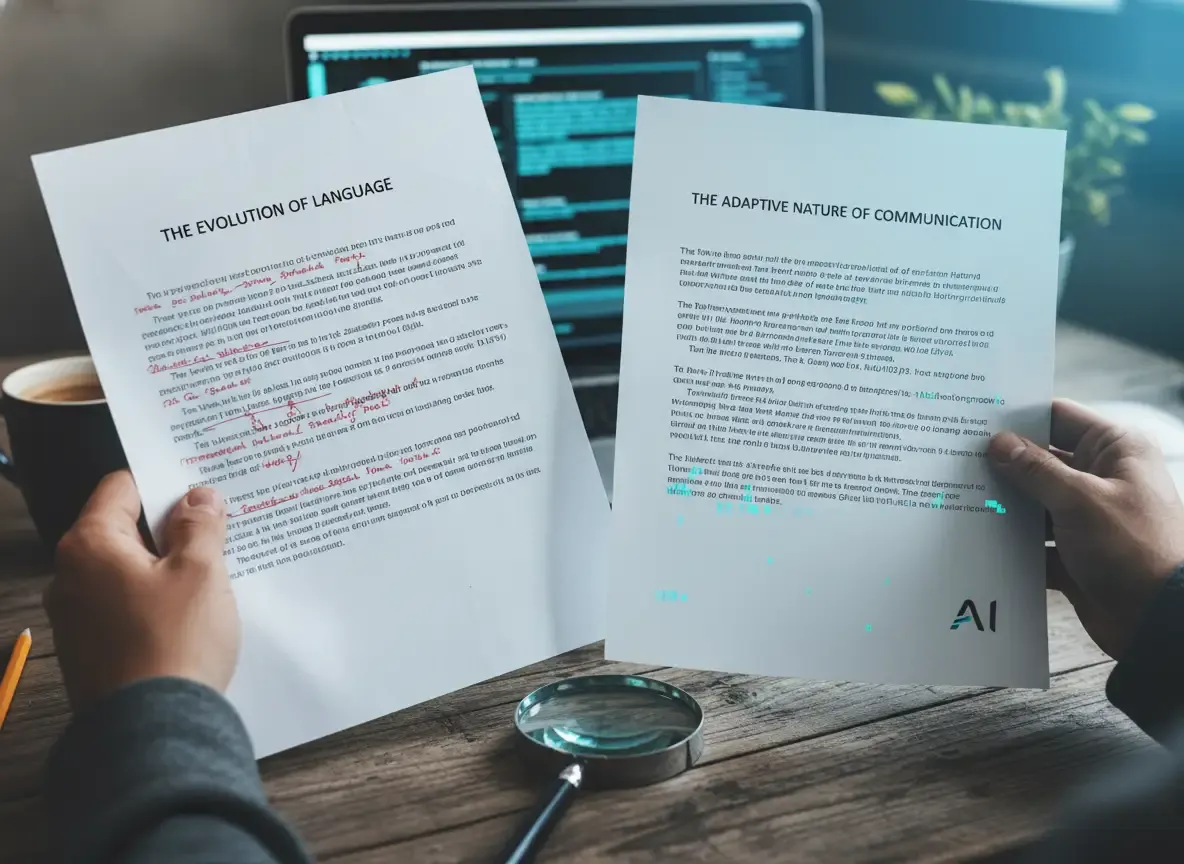
Imagine your child brings home a perfect essay. It's polished and smart, but it just doesn't sound like them. Or maybe you're a teacher, staring at a paper that feels... off. In today's fast-paced world, a new question often comes to mind: Did AI write this?
AI writing tools are everywhere now. They can whip up an essay in mere seconds. This makes them very tempting for students facing deadlines or tough assignments. However, schools are quickly learning how to spot these AI-made papers. It's not just about catching cheating. It's about making sure your students actually learn and grow their own ideas.
What's the Big Deal with AI Essays?
Tools like ChatGPT, Google Bard, and many others can write almost anything you ask them to. They can draft emails, summarize long books, and yes, even write entire essays. For students, this can feel like a really quick fix. Instead of spending hours researching and writing, you might be tempted to ask an AI to do it for you.
But here's the real problem: learning isn't just about the final paper you turn in. It's about the entire journey. It's about thinking deeply, organizing your thoughts, and putting them into your own unique words. When an AI does all the work, students miss out on developing these vital skills. It's like trying to learn to ride a bike by simply watching someone else do it. You won't truly understand how to balance or pedal until you try it yourself.
For teachers, this presents a huge challenge. How do you fairly grade work when you don't know who truly wrote it? How can you be sure your students are actually understanding the material you're teaching? The goal of education is to foster independent thought, and AI can undermine that if used improperly.
How AI Writing Is Different from Human Writing
AI writing is getting better every single day. However, it still has clear tells. Think of it like a very good mimic. It can sound human, but it often misses that unique spark that makes human writing truly special and personal.
AI tools are designed to be helpful, factual, and clear. They pull information from vast amounts of data to create text that sounds correct. But this often means their writing can be a bit... predictable. It might lack the unexpected turns or the raw emotion that you find in human-crafted stories or arguments.
The AI Voice vs. Your Voice
Your writing style is truly unique. It's shaped by your personal experiences, how you think, and even the way you speak. AI, on the other hand, doesn't have experiences or feelings. It creates text based purely on patterns it has seen in millions of other texts. This fundamental difference leads to several common distinctions you can spot in AI-generated work.
This can lead to a few common differences you'll notice:
- Perfect Grammar, Flat Tone: AI often uses flawless grammar and spelling. But sometimes, this very perfection makes the writing sound a bit lifeless. It might read like a textbook. It often lacks humor, passion, or a strong personal opinion, making it feel impersonal.
- Generic Answers: AI tries to give you the most common or safest answer. It tends to avoid taking risks or expressing truly original thoughts. This means essays might be accurate but also very general. They often lack deep insight or a fresh perspective.
- Repetitive Structure: AI often follows a very standard essay structure. You'll see a clear introduction, typically three body paragraphs, and a conclusion. While this is good practice, human writers sometimes experiment more. They might break the mold to create a more engaging piece.
- Odd Word Choices: Sometimes, an AI might use a big, fancy word when a simpler one would do just fine. Or it might use a phrase that doesn't quite fit the context. This can make the writing sound a little unnatural or forced, like someone trying too hard to sound smart.
Quick Tip: Human writing often has little quirks. It might show moments of confusion, or even small mistakes. These elements often reveal that a real person was thinking and struggling with ideas. AI tries to avoid these imperfections, aiming for a smooth, error-free output.
Here's a simple way to compare these two styles:
| Feature | Human-Written Essay | AI-Written Essay |
|---|---|---|
| Voice | Unique, personal, sometimes emotional, shows personality, may have quirks | Neutral, formal, often lacks unique character, can feel impersonal |
| Errors | May have small grammar or spelling mistakes, occasional awkward phrases, natural variation | Usually perfect grammar, but can have factual errors or illogical connections |
| Ideas | Original thoughts, unique connections, personal examples, fresh perspectives | Common knowledge, well-structured, but often generic, lacks deep insight |
| Vocabulary | Varied, fits context, sometimes informal, natural word choice | Often formal, uses complex words, can be repetitive or slightly out of place |
| Flow | Natural, sometimes takes detours, can be surprising, shows a human thought process | Logical, predictable, smooth transitions, but can feel stiff or overly structured |
Tools Teachers Use to Catch AI
Just as AI can write, other AI tools are being built to detect AI writing. These tools don't just check for copied words like traditional plagiarism checkers. They look for the subtle patterns that AI writing often leaves behind. This is like looking for a digital fingerprint.
Think of it this way: If a human painter uses broad, sweeping strokes and mixes colors in a certain unique way, an AI painter might use very precise, repeated brushstrokes. It might blend colors perfectly every time. An AI detection tool tries to spot those precise, repeated patterns in the words and sentences you submit.
Some popular tools schools are using include Turnitin's AI detection feature, GPTZero, and others. These tools analyze things like:
- Sentence Complexity: AI often writes sentences that are consistently complex or consistently simple. It often lacks the natural variation you see in human writing. A human writer will naturally mix it up.
- Word Choice Patterns: Certain words and phrases are more common in AI-generated text. The detection tools look for these specific digital fingerprints. They identify common linguistic habits of machines.
- Predictability: How likely is the next word to appear based on the previous words? AI text tends to be more predictable than human text. It often chooses the most statistically probable word, rather than a creative or unexpected one.
It's important to remember that these tools are not perfect. They are getting better all the time, but they can sometimes make mistakes. A human-written essay might accidentally trigger an AI detector. Conversely, an AI-written essay might slip past one. That's why teachers don't rely on just the tools alone. They use their own experience and judgment as well.
Beyond the Tech: What Teachers Really Look For
AI detection tools are one piece of the puzzle. However, experienced teachers have other powerful ways to spot AI-generated work. They often use what we call the "smell test" , a gut feeling backed by years of observation and knowing their students.
The "Smell Test" for AI Essays
-
A Sudden Change in Style: A student who usually struggles with grammar or organization might suddenly turn in a flawless, perfectly structured essay. This is a huge red flag for any teacher. Teachers know their students' writing abilities and voices very well. They can easily spot an unnatural leap in quality.
-
Too Perfect, Too Fast: If an essay has absolutely no errors, perfect flow, and addresses every single part of the prompt, but the student usually needs a lot of help, it raises questions. Human writing, especially for students, often has some rough edges or areas for improvement. It shows effort and growth, not instant perfection.
-
Generic, Vague Answers: AI is designed to be helpful, not deep. Essays might be full of general statements and lack specific examples, personal insights, or truly original arguments. It hits all the required points but doesn't say much new or offer a unique perspective.
Example: An essay about climate change might list common solutions like recycling and renewable energy. However, it won't offer a fresh perspective or connect it to a local issue in a unique way that a student living in that community might. It will feel impersonal. For more on how AI can create convincing but fake content, you can check out our article on how to spot AI-made videos.
-
Odd Vocabulary or Phrases: Sometimes, AI uses words that sound impressive but don't quite fit the context. Or it uses phrases that feel a little unnatural or overly formal. It's like someone trying to sound smart by using a thesaurus too much, resulting in awkward phrasing.
-
Lack of Process or Understanding: A teacher might ask a student to explain their essay. They might ask about their research, or share their rough drafts. A student who used AI might struggle to explain their own work. They might not know where their ideas came from, or how they structured their arguments. They might not even understand the complex words used in the paper they supposedly wrote.
A Real-World Example (Illustrative)
Ms. Chen teaches 10th-grade English. She assigned an essay on the themes in "To Kill a Mockingbird." One student, Leo, usually turns in essays that are decent but often have a few run-on sentences and some unclear ideas. His voice is usually quite casual and direct.
This time, Leo's essay was stunning. It had perfect grammar, sophisticated vocabulary, and a structure that flowed like a professional article. It covered all the points beautifully, but it felt... cold. It lacked Leo's usual quirky observations or the slightly hesitant way he sometimes explored complex ideas. Ms. Chen felt a prickle of suspicion. The essay simply didn't feel like Leo.
Ms. Chen didn't immediately accuse him. Instead, she called Leo over to her desk after class. "Leo, this is a very well-written essay," she started, her voice calm but observant. "Can you walk me through your brainstorming process? What made you decide to focus on the theme of prejudice in this specific way?"
Leo shifted uncomfortably in his seat. He stammered, avoiding her gaze. He couldn't clearly explain his thesis. He also couldn't explain how he found the quotes he used. He couldn't talk about the 'aha!' moments he supposedly had while writing. He just kept repeating, "I just wrote it." His inability to discuss his own supposed work was a bigger red flag than the essay itself. It was clear the process of learning and writing hadn't happened for Leo. He had missed out on the true educational experience.
Why Students Might Use AI (and Why They Shouldn't)
Students might turn to AI for many understandable reasons. They might be overwhelmed with homework, struggling with a particularly tough topic, or simply curious about what AI can do. The pressure to get good grades can be incredibly intense, pushing some to seek shortcuts.
However, using AI to write an essay is a form of cheating in school. It prevents students from developing crucial skills. These include critical thinking, research, organization, and clear communication. These are the exact skills that will help them succeed not just in school, but in life and future jobs. They are foundational for any career path.
Learning to write well is like building a muscle. You have to practice consistently, make mistakes, and learn from them to get stronger. If an AI does all the heavy lifting for you, your own writing muscle never gets stronger. It also means you're not truly engaging with the material. This defeats the whole purpose of education, which is to foster genuine understanding and personal growth.
What You Can Do Right Now
Whether you're a parent, a student, or an educator, there are important steps you can take to understand and address the rise of AI in schoolwork.
-
Talk About AI Openly: Have honest conversations with your children or students about AI tools. Explain what they are, how they work, and your school's specific rules about using them. Discuss the difference between using AI as a learning helper, like a smart dictionary, versus using it to do all the work for you.
-
Focus on the Process, Not Just the Product: Encourage students to show their work along the way. Ask for outlines, rough drafts, and notes. Make them explain their ideas out loud to you. This makes it much harder for AI to do the entire task unnoticed, and it reinforces the learning journey.
-
Teach Critical Thinking and Research Skills: Help students understand why they are writing and how to find credible information. The better they are at thinking for themselves and questioning sources, the less appealing a generic AI answer will be. Our resources at Truth Lenses can offer more insights into spotting fake information and developing media literacy.
-
Embrace AI Ethically (Where Allowed): Some schools are exploring how students can use AI as a tool for brainstorming, summarizing, or getting feedback. However, it should not be used for generating final drafts. Understand your school's specific policy and use AI responsibly and transparently.
-
Learn the Signs: Familiarize yourself with the common characteristics of AI-generated text. The more you know about how AI writes, the better you can spot something that doesn't feel right. Truth Lenses offers tools and guides to help you understand all forms of AI-made content, helping you stay informed.
Frequently Asked Questions
Can AI detection tools be fooled?
Yes, AI detection tools are not perfect. Smart students might try to trick them by changing a few words or using specific techniques to make the text sound more human. However, teachers often combine these tools with their own judgment and knowledge of the student's usual work. This human element is crucial for accurate assessment.
Is using AI always cheating?
It depends entirely on the school's rules and how the AI is used. If a student uses AI to write an entire essay and turns it in as their own original work, that is almost always considered cheating. If AI is used only for brainstorming ideas or minor editing with explicit permission from the teacher, it might be allowed. Always check your school's specific policy to be sure.
What if my teacher thinks my human essay is AI?
If you wrote your essay yourself and a teacher suspects AI, don't panic. Be prepared to explain your entire writing process. Show your notes, rough drafts, and any research you did. Explain your unique ideas and how you developed them from start to finish. This transparency can help clear up any misunderstandings and prove your work is authentic.
Understanding how AI works and how it's detected is key to navigating the future of education. Keep learning and using the tools at Truth Lenses to stay informed about online deception and AI-made content. Your ability to discern truth from AI-generated fakes will be an invaluable skill.